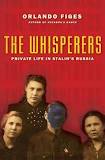
 This book by Orlando Figes is exciting, terribly depressing, and cautionary. Based on hundreds of in-depth interviews and thousands of letters, diaries, and government documents, Whisperers ((more here on Figes’ website)) puts real people in place of the faceless numbers that constitute our usual image of the human costs of Stalinist Russia – the 10 million lost during collectivization, the same or larger number disappeared during the various Terrors and the 20 million or more dead during the Great Patriotic War (aka WWII). For those who do not have much background in Russian and Soviet history Figes provides concise sketches of key political and economic developments covering the entire span of Soviet Russia. You will not feel at a loss during the NEP period nor the ensuing collectivization and the round ups of “kulaks”. This allows you to understand the private lives with a reasonable understanding of the context.
But the real contribution of this book is its discussion of the truly radical efforts by the Communist Party to crush the family as a basic unit of society and replace it with other institutions. The goal is to shape the new Soviet man. The coercive intrusion by the state into every aspect of daily life is comprehensive – it adds new depth to understanding the machinery of a totalitarian state.

 When you walk up to an ATM machine you conduct a two factor authentication before you make a transaction. You must physically have the card (factor one) and insert it in the machine and then you have to know the pass code (factor two). This combination makes it very unlikely that the person performing the transaction is not you.
  There has rightfully been considerable outrage over this week’s revelations that the Federal government has been sucking up information on virtually every aspect of our lives, email, telephones calls, pictures, credit card and banking transactions, and so on. Unfortunately almost all of this discussion is taking place without a useful sense of the scope, scale, and trajectory of the government’s war on terror.
  John le Carré, author of many beloved spy novels, e.g., Tinker Tailor, Soldier, Spy, wrote this piece critiquing the then upcoming War on Iraq in January 2003. Besides pointing out the very strong connections between big oil and the Bushes, many other elements of the critique continue to be applicable to current American foreign policy.
 The Greenport Historical Society hosted a lecture by Sally Naramore on Wednesday evening 4/18/2013 at the Greenport Town Hall. Her presentation which included visuals not included here, focused on immigration to Hudson in the 19th and 20th centuries.