Authenticity in Hudson, NY

authentic |ôˈθentik| (abbr.: auth.)

adjective

  • of undisputed origin; genuine : the letter is now accepted as an authentic document | authentic 14th-century furniture.
  • made or done in the traditional or original way, or in a way that faithfully resembles an original : the restaurant serves authentic Italian meals | every detail of the movie was totally authentic.
  • based on facts; accurate or reliable : an authentic depiction of the situation.
  • (in existentialist philosophy) relating to or denoting an emotionally appropriate, significant, purposive, and responsible mode of human life ((definition adapted from Dictionary Version 2.1.1 Apple, Inc.)

In part because of the vigorous discussion in the various “Signage” postings in the Hudson Business Coalition discussion group and other discussions I have had recently about Hudson, I have come to think that a major feature of Hudson is authenticity. Hudson demonstrates authenticity in all four senses described in the definition above. People who own businesses here, whether in antiques, art, music, and many more, do so from some central personal passion. Visitors experience this directly. Visitors must digest the experience and make it their own. And, many times businesses receive direct feedback about their passions from visitors and not in frequently new perspectives and information about their passions. Continue reading

Mayor Scalera’s “Naive or delaying LWRP passage?”

Mayor Scalera’s commentary, “Naive or delaying LWRP passage?” in today’s Register Star requires some comment. Here are my comments posted on the Register Star website.

First, Mayor Scalera mis-characterizes the potential uses of the waterfront as “recreational boating and perhaps some limited shipping….”. In fact, from my perspective, and from all of the people I have heard talk about the waterfront, the uses included recreational boating, cruise operations, hotel, restaurants, retail shopping stores, galleries, and more. These uses fit into a larger picture that the future of jobs in Hudson is tied to the extension of the city as an arts, antiques, entertainment, and history destination. This job creation engine has a track record in the city and an obvious future for growth with the addition of the waterfront as part of the overall destination package.

The problem is that none of that is possible with a large scale industrial use cheek and jowl with the rest of the waterfront. The choice we are facing is a trade off between a limited number of seasonal jobs hauling gravel (it was reported elsewhere in today’s Register Star that Calarusso only operates during non-winter months) or developing the track the city has been on for the past 10 to 15 years, becoming a destination for those interested in arts, antiques, entertainment, food and history. I want to place my bet with that development path.

A second point might be to point out that Mayor Scalera went to lengths to point out the Open Space Institute and Scenic Hudson would not support an eminent domain taking. That is not the only way in which those organizations might be involved. A simpler path is the old-fashioned one of buying the land in question.

As someone who has only lived in Hudson for a year and half of the twenty three years of the LWRP process, it seems wise to continue to get the policies right even at the cost of a bit more time.

Mark Orton

Internet Service, the New York Times and Choice in the World of Mono-Duo-poly Capitalism

What Planet is the Times Orbiting?

Today’s New York Times editorial page included a piece titled “How Fast Is Your Broadband?“. It provides a reasonable review of the sad performance of the Internet service providers in the US. It is widely known that Internet service providers like Comcast, Time-Warner and locally Mid-Hudson Cable chronically provide significantly less than their advertising claims. Here in Hudson, NY Mid-Hudson claims “blazing speeds” of 5 MB/sec (download). Repeated measurements, now numbering over 280 in the last six months prove that they provide speeds 30% less than this mark. Service technicians from M-H have acknowledged that this is the typical service they provide.

Worse is that the latency frequently reaches 2 seconds instead of being under the 100 milliseconds that is commonly accepted as OK latency on the Internet.. This means that after your click your mouse on a link in a browser, you can literally count “1 Mississippi 2 Mississippi” before you get any response to your query. This latency disables common communications tools like VOIP telephone services and audio and video services via Skype or Google. Continue reading

How Did We Come To Consider Corporations to Be Natural Persons? – What To Do Next?

This week’s decision by the US Supreme Court to allow corporations, including unions, to hold full rights to free speech and political action under the First Amendment to the Constitution once again reminds me of the strange practical and ethical relationship we have with corporations. In the 1886 ruling, Santa Clara County v. Southern Pacific Railroad Company1, the court reporter wrote in a summary: “The court does not wish to hear argument on the question whether the provision in the Fourteenth Amendment to the Constitution, which forbids a State to deny to any person within its jurisdiction the equal protection of the laws, applies to these corporations. We are all of the opinion that it does.”  I have not read very much at all about the history of how corporations came to be persons and I will not enter into the disputes about how this came to be. It is clearly a well established fact in our laws that corporations are people.

With this new policy handed down by the Supreme Court,  corporations can now spend unlimited amounts of money carrying out political activities. The are many troubling aspects of this situation.  Besides the obvious fact that an artificial socio-economic artifact like a corporation can not possibly be a natural person, there are numerous features of corporations that make them particularly dangerous to us human beings. Corporations never die, excepting the rare death by dissolution. Corporations act globally with many agents in place to carry out policies that favor the corporation wherever and whenever required. Through the wonders of contracts and financialization of assets corporations can appear and disappear from any locality at will. One can observe an example of this phenomenon several years ago when corporations like Tyco International moved its headquarters to an off-shore island to avoid US corporate taxes. This, despite the fact that Tyco had dozens of manufacturing facilities and other operations employing thousands here in the US. Continue reading

Book Review: Manias, Panics, and Crashes: a history of financial crises by Kindleberger

Manias, Panics, and Crashes: a history of financial crises, fourth edition by Charles P. Kindleberger (New York: Wiley 2000)

Manias,Panics,and Crashes by KindlebergerA recent Wall St Journal article described this book as a “must read” classic for anyone involved in financial markets. I have been involved directly in financial markets in two ways recently. First, I spent a year chasing around chasing angel investors and venture capitalists during the DotCom boom to fund Valuedge (the software company I co-founded in 1999 and left in 2004, though I still hold a large ownership interest).  Second, I receive quarterly statements for my 401K retirement investments. Primarily driven by my experiences with Valuedge and the phenomenal boom time of the DotCom era, I read through Kindleberger’s durable book (originally published in 1978 and never out of print since).

Although I have come to refer to the year 2000 as the Tulip Phase of Valuedge after the well-known Dutch tulipmania in the 1630s. Little did I know that financial bubbles, booms, and the inevitable crashes and depressions are a very common feature of capitalism. The first couple of chapters describe or mention dozens of bubbles and booms located around an amazing array of geopolitical centers. These have been focused on anything and everything: the well-known tulips in the 1630s; railroads; copper; English country houses; agricultural land; private companies going public (Britain 1888, US 1928 and IPOs 1998-2000); and many others.

The first lesson, then, is that booms and speculative bubbles are a commonplace feature of the capitalist world.

So, why do these bubbles and speculative manias occur? The answers are complex, involving human psychology, malfeasance, regulation (or lack), banks, and government. Read Kindleberger .

An important explicit message from Kindleberger is that economists’ models of “homo economicus” and “the market” are far from a useful mirror of what actually goes on. People are not even vaguely rational in their economic behavior and markets never constructively approach the model of a market found in Econ 101 or for that matter anywhere else that I have ever heard of.

This is not just an academic concern. In recent years our politics has displayed a dominant rhetoric that calls for the application of “market solutions” to almost every area of our lives, particularly those where traditionally we expect government to provide services, regulations, etc. Instead, we now reflexively think that “market solutions” are inherently more efficient and effective than government services. Liberals, trapped in their abandonment of even the moderate criticism of capitalism that the Catholic Church, for instance, engages, have provided no useful critique of “market solutions” as a universal policy approach.

At a practical level, this public policy fixation on “market solutions” combined with a generalized attack on all government spending, is driving a generalized impoverishment of the public infrastructure of our civil society and not coincidentally an enrichment of the wealthy and particularly the super-rich.

I recommend this book to anyone with an interest in the day-to-day political and economic life of the world.

Yottabytes and the National Security State

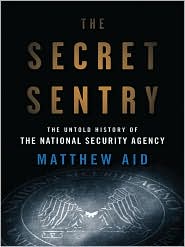
The current New York Review of Books has an article by James Bamford, “Who’s in Big Brother’s Database” that reviews the new book by Mathew M. Aid, The Secret Sentry: The Untold History of the National Security Agency . I have gotten in line at my local library to read this book and will make further comments after that.

Secret Sentry by Mathew AidMeanwhile, the Bamford article mentions the construction boom at NSA (National Security Agency) with a doubling of its headquarters and million sq. feet of data storage in the Utah desert costing some $2 billion. This to store the data from all of NSA’s spying that by 2015 will be spoken of in terms of yottabytes.

Now, before you think that Bamford is mainlining old Star Wars characters, a yotta- is the largest large number prefix officially recognized in the scientific lexicon. At our house we are approaching 1/2 Terabyte (1012) in our total digital stores, mostly photos. Really large corporate databases are measured in Petabytes (1015). A Yotta is 1024.

Are you feeling safer?

Do you really think that any email sent or telephone conversation you have had since 2002 or 2003 is not logged in the vast secret Security State Apparatus??

I guess that a National Security State (Empire) that has had over 800 military bases throughout the world (see an earlier posting on this topic) to assure our influence elsewhere can not resist the opportunity the state of so-called war we have been in since 2001 to penetrate into every American’s life.

Book Review: Diamond Street – Hudson, NY: the story of the little town with the big red light district

Diamond Street by Bruce hallDiamond Street: The Story of the Little Town With the Big Red Light District by Bruce Edward Hall (Black Dome Press, Hensonville NY 1994 and 2005)

This is a fairly readable history of Hudson as seen from the other side of the tracks and from the corrupt office holders in city government and local police. Sheds new light on how Hudson has been dependent for a very long time on “weekenders” to support a significant portion of the local economy. the difference is that the current economy is not dependent on men’s interests in gambling, drinking and sex.

Lots of wonderful stories and much local color and geography. Somewhere a wonderful, marvelous in its excess, statistic appears that Hudson once had 76 bars packed into its 2+ square miles.

Book Review: Looking for Work: Industrial Archeology in Columbia County, New York

Looking for Work by Peter stottLooking for Work: Industrial Archeology in Columbia County, New York, The Emergence and Growth of Local Industry as Revealed in Surviving Sites and Structures by Peter H. Stott, Syracuse University Press, 2007

This is a comprehensive review of industrial sites in 18 towns and the City of Hudson in Columbia County. There is a narrative historical description of the industry in each town and more detailed descriptions of the 134 sites. A great resource for anyone interested in the history of Columbia County and industrial archeology in general. The author has earlier written A Guide to the Industrial Archeology of Boston Proper (MIT Press, 1984)

More information and to purchase here.

A New Thought on Terrorism

An article in today’s NYTimes about cyber crime, malware, etc. suggests to me that another line of attack may be through the Internet against our utilities, telecoms, or financial institutions.

There have already been massive attacks against whole countries with successful breakdowns that lasted for hours and days. Ukraine, Lithuania, and Georgia were targets over the last year. My memory is that suspicions fell to the Russian government because the attacks, in these cases massive Denial of Service assaults, appeared to originate from within Russia.

At any rate, add this to your terror worries.

Pondering at the Food Coop

November 1, 2008

So, here I am having coffee and my favorite lunch, a toasted bagel with peanut butter thinking about the approaching election. Finally this will conclude what has been an overly long campaign, but one with enormous pleasures. Assuming that Obama is not just a curiosity to all those throngs at his campaign events, we will have a President who seems bright, competent, and level-headed with an adequate level if toughness. I don’t expect the kinds of policy directions I would like to see. But, after the last eight years, really the last eleven years, just having a competent President not mired in malevolent Millennial daydreams will be a step forward.

Though I am concerned that the present problems facing us may be beyond the present political system to navigate let alone solve.

Just to mention one. Our overseas empire with almost 800 military bases (see the Base Structure Report from the Pentagon for the data) on every continent proves Eisenhower’s point about the military industrial complex, though in truth this confirms what he is said to have wanted to say, “the military-industrial-Congressional complex”. This monster that consumes almost a trillion $s every year (my calculation includes the Pentagon, CIA, NSA, Energy, and other secret intelligence/military enterprises along with the budgets for the War on Drugs and Homeland Security) continues to grow with no evidence that our security is actually improving. To the contrary, it appears that in some quarters our security may be significantly diminished.